

















The 2G Shutdown Is Coming: What Alarm Installers Need to Do Now

It's Already Happening
The official dates say BT's EE network will start switching off 2G from May 2029, with a UK-wide government deadline of 2033. But if you're waiting for a formal announcement before taking action, you're already behind.
What we're seeing on the ground — across our UK partner base — is that operators have stopped investing in 2G tower maintenance. They're not repairing degraded equipment. They're not replacing faulty components. The towers are still technically live, but the quality of service is deteriorating month by month, especially in areas with marginal coverage to begin with.
The result is that 2G alarm communicators in rural areas, industrial estates on the edge of towns, and buildings with poor cellular penetration are already experiencing intermittent connectivity failures. Signals that used to arrive reliably are now dropping. Devices that showed solid signal strength a year ago are now sitting on the edge of coverage — sometimes connecting, sometimes not.
This is the real 2G sunset. It's not a clean switch-off on a specific date. It's a slow degradation that's already underway, and it makes waiting until 2029 a risky strategy.
Why Operators Stop Maintaining Before They Switch Off
From a network operator's perspective, this makes commercial sense. 2G carries a fraction of a percent of their total traffic. The spectrum it occupies is worth far more when refarmed for 4G and 5G. Maintaining ageing 2G infrastructure costs money for diminishing returns.
So while the official shutdown date is years away, the practical reality is that operators are gradually withdrawing support. A 2G base station that fails in a semi-rural area gets deprioritised. A mast upgrade that could restore marginal 2G coverage gets skipped because the business case doesn't justify it.
For alarm communicators, which depend on consistent, reliable cellular connectivity to deliver signals, this gradual erosion is worse than a clean cutoff. A clean cutoff is easy to plan for. A slow degradation creates a growing population of unreliable sites that are hard to identify until something goes wrong.
The Hidden Danger: Silent Failures
The most dangerous aspect of this isn't that devices stop working all at once. It's that they stop working silently, site by site, as coverage degrades or towers are decommissioned in phases.
A 2G alarm communicator that loses network coverage doesn't throw an error on the alarm panel's keypad. The panel continues to function normally — it arms, disarms, and detects intrusion as expected. But the communication path to the monitoring centre is dead. Alarm signals never arrive. The site appears monitored but isn't.
For alarm companies, this creates a liability exposure that grows with every degraded tower. For end clients, it means their property may be unprotected without anyone realising it until an actual incident occurs.
Insurance Implications
Insurance policies that require monitored alarm systems typically stipulate that the signalling path must be active and verified. If a 2G communicator silently fails because the underlying network has degraded — even before the official shutdown — the monitoring connection lapses, and with it, the policy compliance.
Dual-path signalling, which combines broadband with cellular, is increasingly the baseline expectation from UK insurers. A 2G-only communicator doesn't just fail the connectivity test — it fails to meet the evolving compliance standard altogether.
For alarm companies managing commercial clients, the question isn't whether to upgrade but how quickly you can get through your installed base before coverage becomes too unreliable to trust.
The Official Timeline
For the record, here's where the formal dates stand:
BT/EE: Confirmed 2G switch-off begins May 2029 (announced 2021, reconfirmed January 2025).
UK Government: Published a 2G Switch-off Charter requiring all operators to complete the transition by 2033. Operators must give at least three years' notice before regional shutdowns begin and verify 4G/5G coverage exists before decommissioning 2G in any area.
Vodafone, Three, O2: Working to their own timelines within the 2033 framework. No specific dates published yet.
The charter specifically calls out IoT devices as a key concern, noting that "many Internet of Things devices currently use the 2G network, including devices which support life-critical services." Alarm communicators fall squarely into this category.
BT has explicitly stated that "card payment alarms, security systems, and door entry systems" relying on 2G must be upgraded or replaced, and that the responsibility sits with the equipment provider — not with BT.
What Needs to Happen Now
1. Audit Your Installed Base
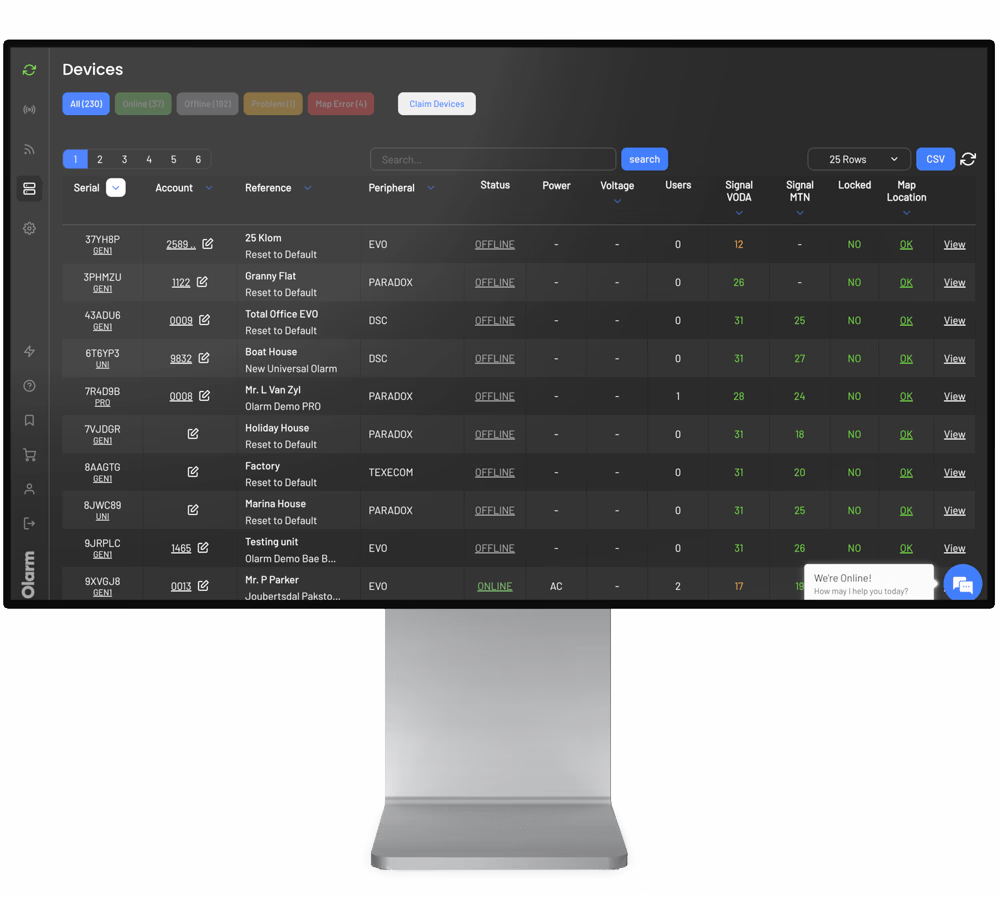
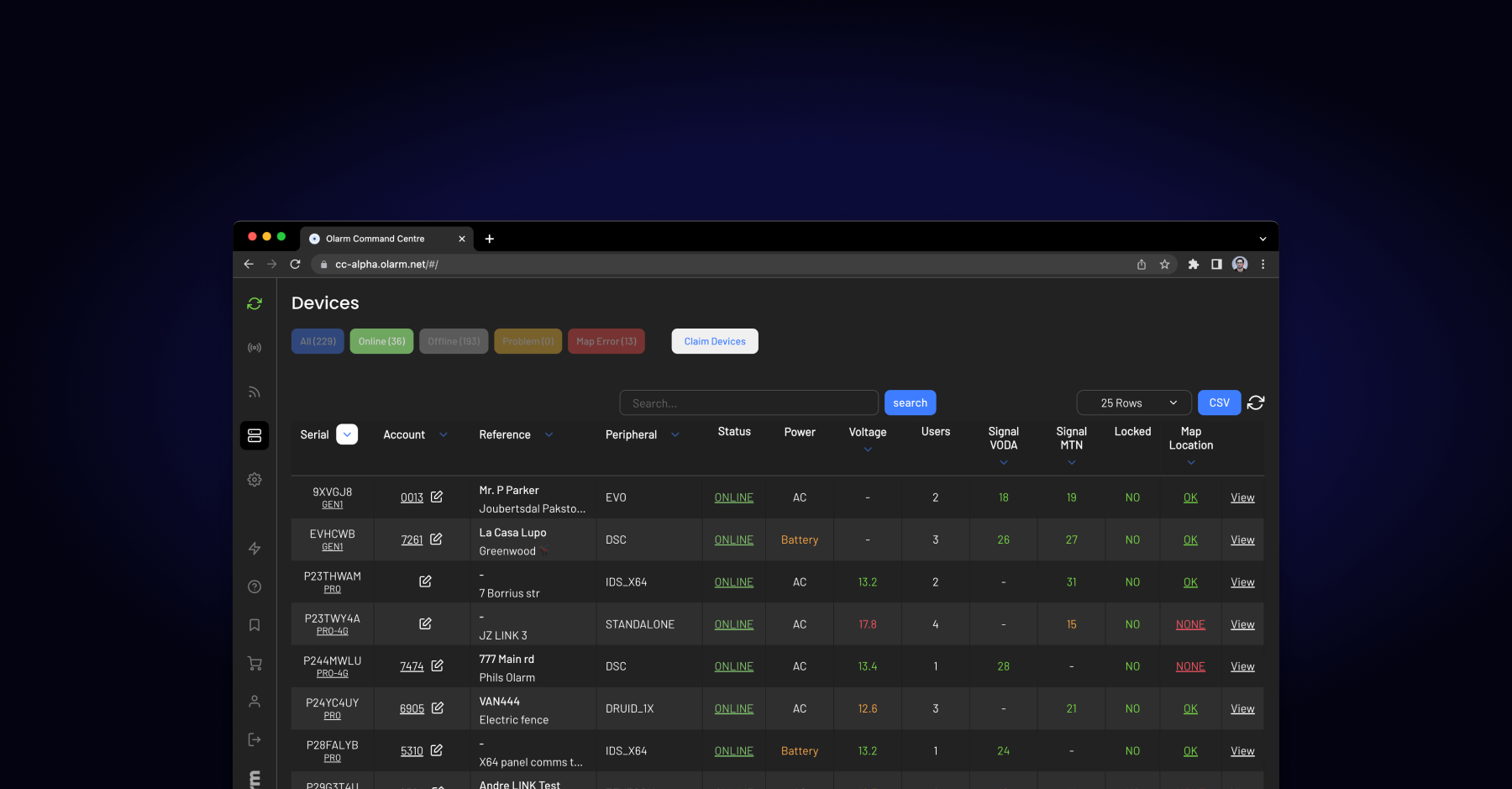
The first step is knowing how many 2G devices you have in the field and where they are. If you're an Olarm Partner, Command Centre makes this straightforward: the Devices page includes a "2G Only" filter that instantly shows every legacy device in your fleet with serial numbers, locations, and client details.
If you're using other communicators, you'll need to cross-reference your installation records against communicator model numbers to identify which units are 2G-only. Pay particular attention to sites in marginal coverage areas — those are the ones most likely to be failing already.
2. Plan the Replacement Programme
Don't wait for 2029. With coverage already degrading, the replacement programme should start now. A company with 500 2G devices needs to schedule, procure, and install replacements across its client base. At a pace of 10 replacements per week, that's a full year of work. Factor in client scheduling, access issues, and supply chain timelines, and it compresses quickly.
Starting now means you can spread the cost and workload. Waiting means a scramble as coverage worsens and every alarm company in the UK competes for the same installation slots.
3. Choose a Future-Proof Replacement
The worst outcome is replacing a 2G communicator with a 3G unit that will also need replacing when 3G shuts down. The UK government's charter signals that 3G will follow on a similar timeline. Any replacement should be 4G-capable at minimum, with WiFi as an additional path for redundancy.
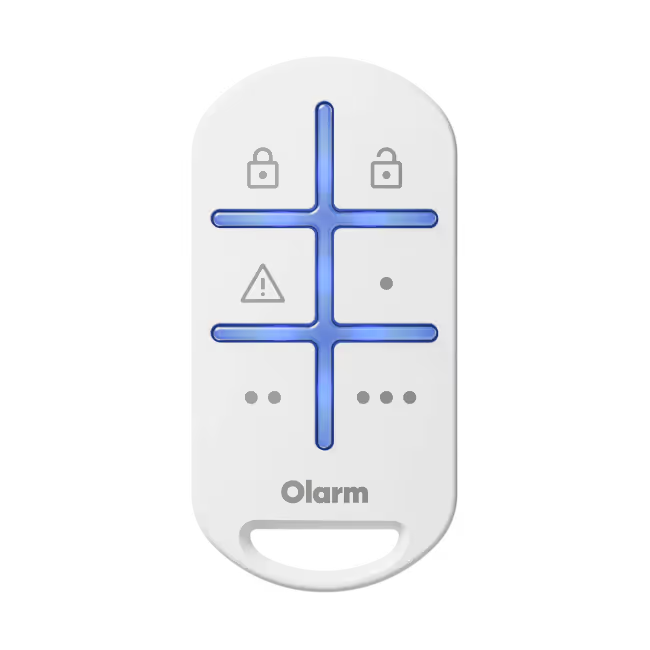
The Olarm MAX connects over dual-SIM 4G, WiFi, and 0G (Sigfox) simultaneously, giving each site up to four independent communication paths. If one network drops, signals route through another automatically. There's no single point of failure and no dependency on any one carrier's infrastructure.
It supports the same UK alarm panels that 2G communicators are typically connected to — Texecom Premier and Veritas, Honeywell Galaxy G2 and G3, Orisec, and Paradox — so the upgrade is a communicator replacement, not a full system rip-and-replace.
4. Use the Upgrade as a Revenue Opportunity
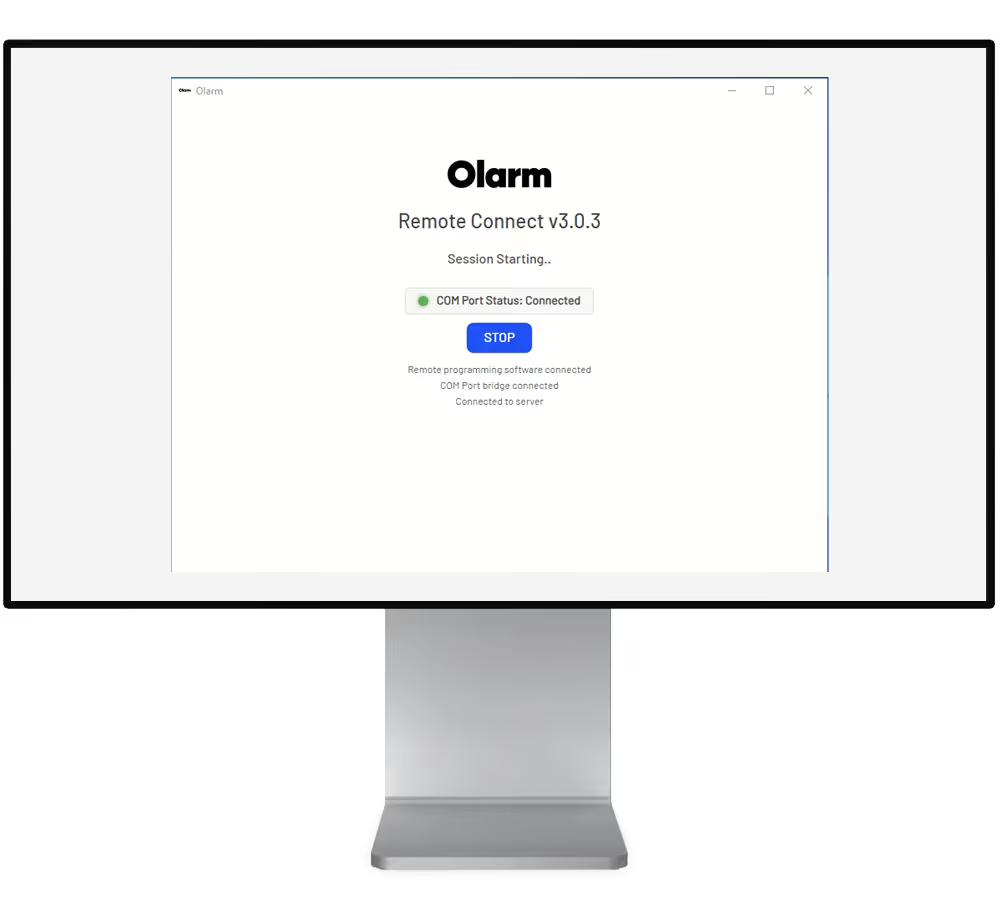
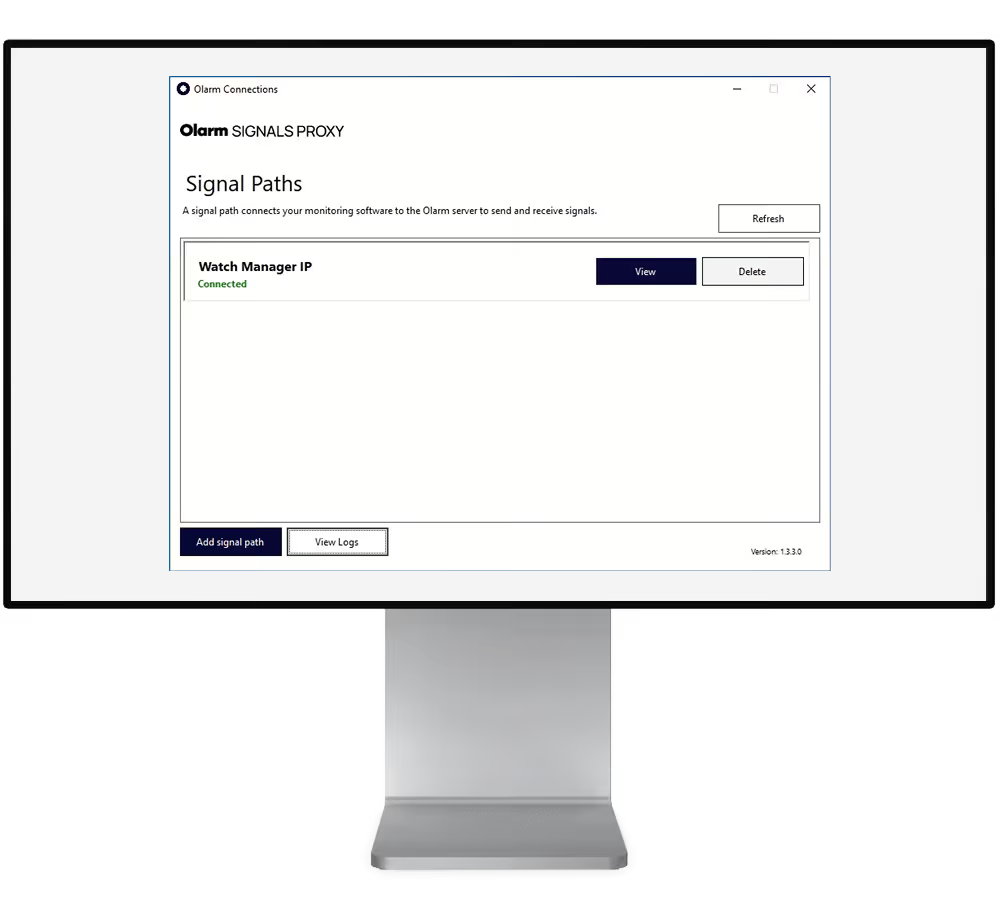
Every 2G replacement is a client touchpoint. It's an opportunity to upgrade the service offering: add app control via the Olarm APP, introduce remote programming via Remote Connect (reducing future site visits), and move the client onto a monitored plan with signal delivery through SIGNALS PROXY.
The companies that move first will lock in their client base with modern hardware and recurring revenue. The companies that wait will be doing emergency replacements while competitors have already upgraded their customers.
What Olarm Offers UK Installers
Olarm is active in the UK market with hardware, support, and a partner programme built for this transition:
Olarm MAX — 4G + WiFi + 0G communicator with dual SIM slots. Multi-path redundancy means no single network dependency. Supports Texecom, Honeywell Galaxy, Paradox, Orisec, DSC, and IDS panels.
Command Centre — Cloud-based device management with a 2G device filter for fleet auditing. Free firmware updates, remote programming via Remote Connect, and signal delivery via SIGNALS PROXY — all included.
Olarm Academy — UK-specific training courses for Command Centre, device installation, and monitoring setup.
Partner programme — No upfront licensing fees. Command Centre, Remote Connect, and SIGNALS PROXY are included at no extra cost.
If you're a UK alarm installer or monitoring company, don't wait for the official switch-off date. The network is already degrading. Register as an Olarm Partner at olarm.com/become-a-partner to start planning your replacement programme now.
Recent news
What Is Olarm Command Centre? A Guide for Monitoring & Response Companies
Smart Security for Estates, Complexes & Gated Communities in South Africa